

Wait! Don’t Go Yet! 👋
We see you eyeing those adorable outfits! 😍 Before you leave, here’s 10% OFF your first order!
Hurry, your little one’s next favorite outfit is waiting! 🛍️✨
Practical homeschool storage ideas for small homes, including how to sort supplies, use vertical and hidden space, set up grab-and-go bins, rotate materials and keep paper under control without a dedicated classroom.
Quick answer: in a small home, store homeschool supplies by how often you use them. Keep daily items in a grab-and-go bin or cart, weekly items on a nearby shelf, and seasonal or occasional items in closed boxes out of sight. Use vertical space, under-bed and behind-door storage, label everything, rotate materials every few weeks, and set a firm limit on how much paper you keep.
Homeschooling creates stuff. Books, workbooks, art supplies, science kits, manipulatives, folders, finished projects and a printer all want a home. In a spacious house, an extra room can swallow the pile. In an apartment or a small house, the pile quickly takes over the table where you also eat dinner.
The good news is that small spaces force good habits. With fewer places to hide clutter, you learn to keep what you use and let go of the rest. This guide shows how to sort your materials, use every inch of space, build a simple daily system and keep paper from burying you. None of it requires a dedicated classroom or a big budget.
If you are still deciding what to buy, our guide to homeschool supplies by grade band helps separate needs from extras. For the bigger picture on layout, see how to set up a homeschool space on a budget.
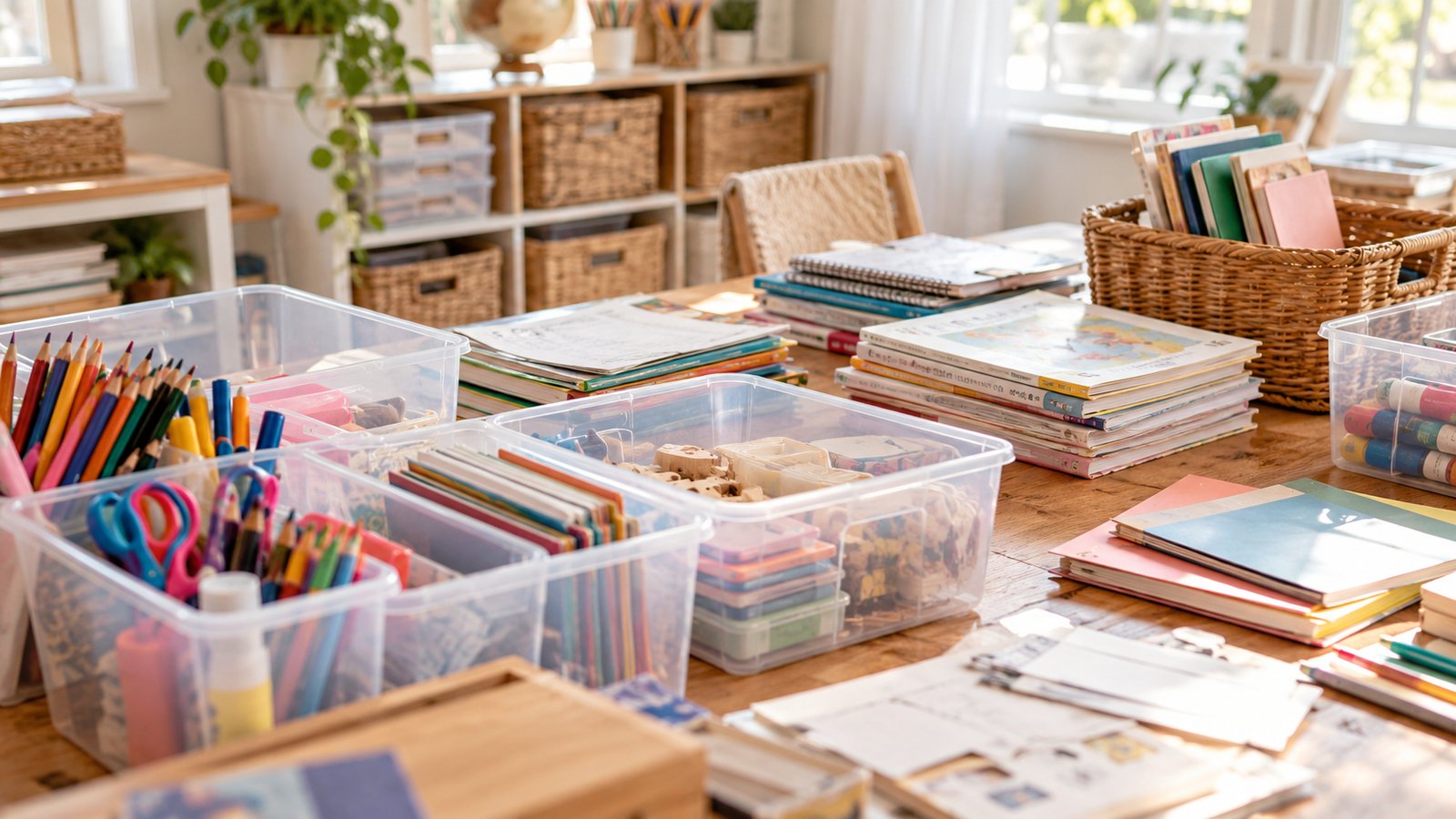
Before buying a single bin, empty the pile and sort. Make three categories.
Daily items are what you use almost every school day: core books, workbooks, pencils, a notebook, a few reading books. These need the easiest access.
Weekly items appear once or twice a week: science supplies, art materials, games, extra readers, maps. Store them nearby but not necessarily in sight.
Occasional items come out rarely: seasonal unit study kits, big projects, old curriculum you may reuse, craft supplies for special occasions. These can live in closed boxes in a closet, under a bed or on a high shelf.
Then ask hard questions about each item. Have you used it in the past two months? Does it fit your current approach? Is it for a child who has outgrown it? Items you have not touched, and do not plan to touch, can be sold, donated or passed to a friend. Letting go frees space that is worth more than a rarely used workbook.
Be honest about duplicates. Four half-used glue bottles, ten dried-out markers and several pencil sharpeners crowd shelves. Hold on to a working set, and recycle or donate the rest.
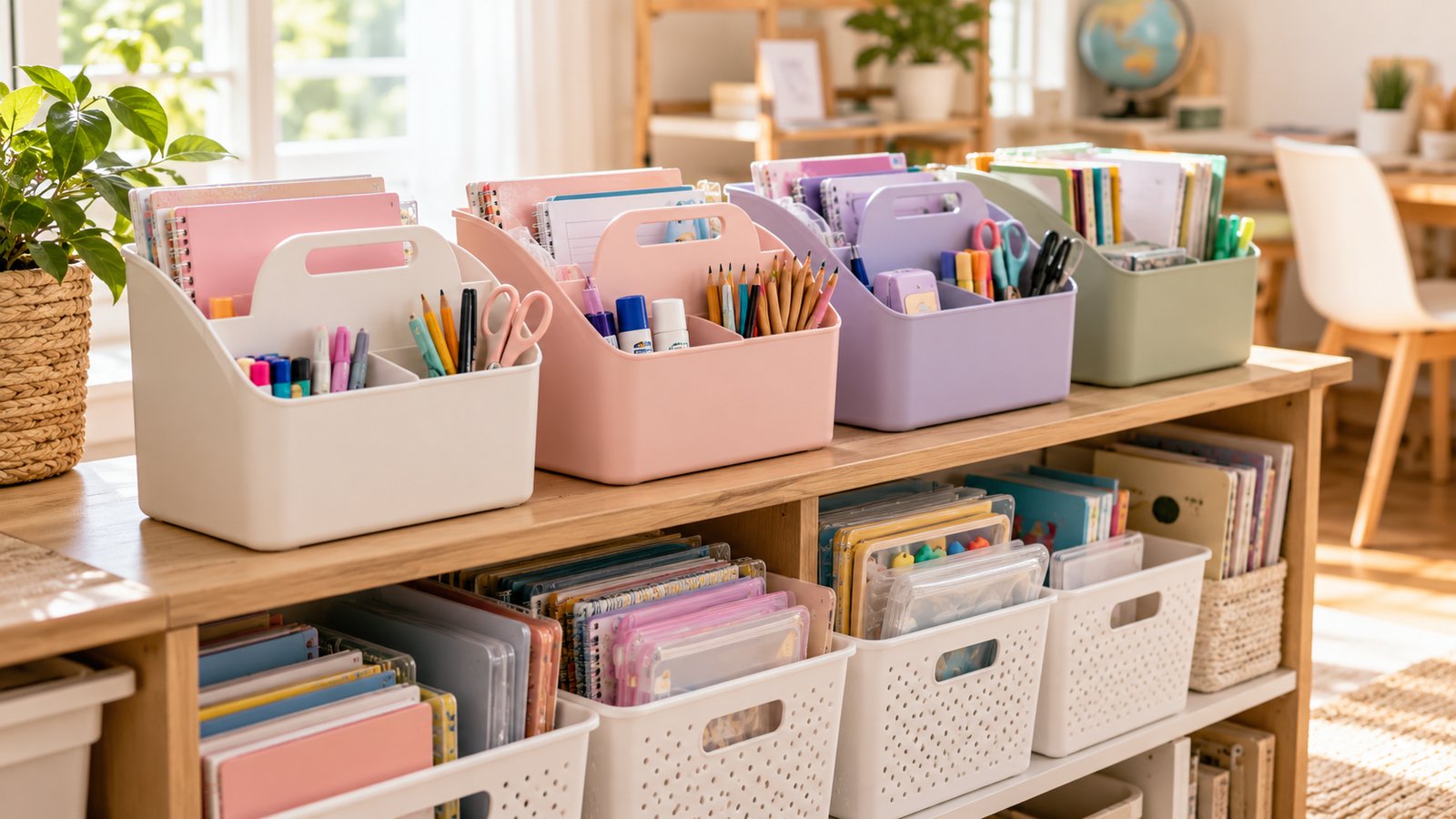
A small home benefits from a portable setup. A rolling cart, a basket for each child or a set of bins that fits on a shelf lets you start school anywhere and clear it in minutes.
A daily cart might hold:
When lessons end, the cart rolls into a closet or against a wall. The table returns to being a table, and the home returns to being a home.
Basket-per-child systems work well with several kids. Each child gets a bin with their name, holding their daily work. The setup keeps papers from mixing and gives older children ownership of their materials.
Weekly bins can be a rotation, such as a science bin, an art bin and a games bin. Pull out one bin at a time, and put it away when the activity ends. Our guide on planning a homeschool schedule that works explains how to fit these rotations into a weekly rhythm.
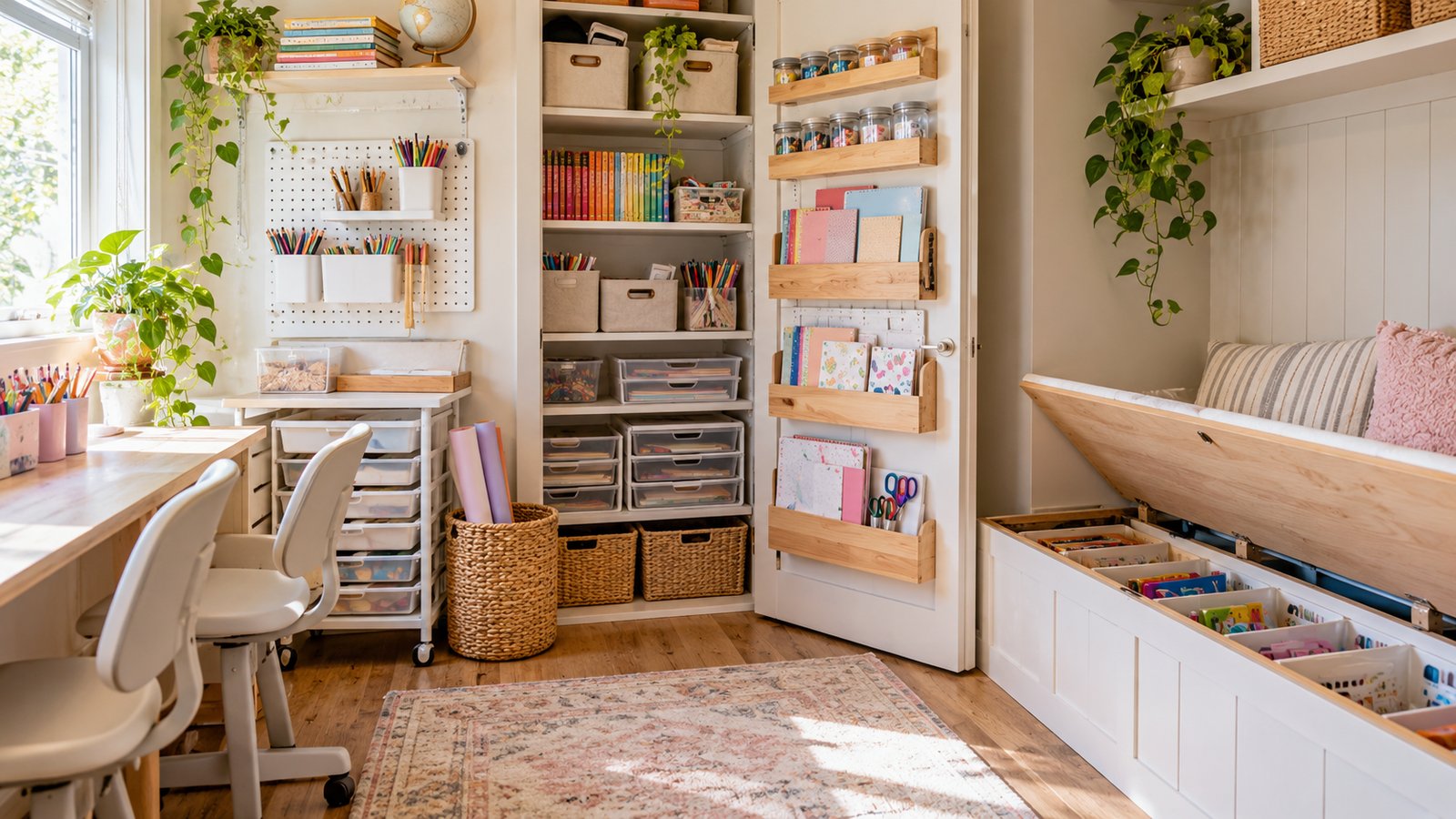
Floor space is limited, but walls and corners are not. Look up and look behind.
Check weight limits on shelves, and anchor tall furniture to the wall so it cannot tip over, especially with children around. Heavy books belong on lower shelves.
Dual-purpose furniture helps. A dining table with storage underneath, a desk that folds against the wall, or a bookshelf that doubles as a room divider all multiply what a small space can do. Our guide to hands-on learning materials for early elementary can help you decide which materials earn their shelf space for young children.
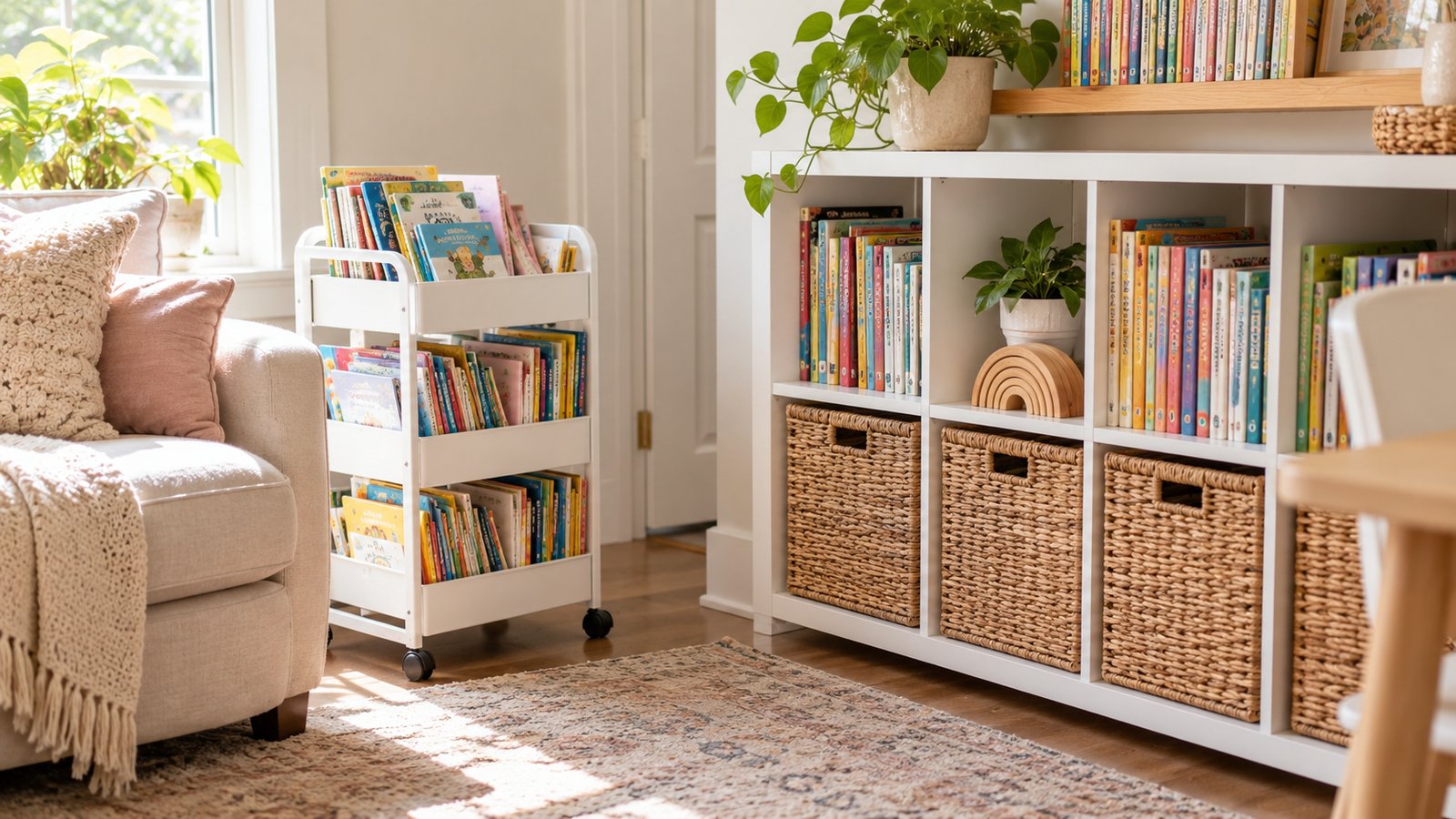
Books are the biggest space hog in many homeschools. A few strategies keep them manageable.
Use the public library as your main collection. Borrow topic-based stacks for a unit, return them when you finish, and keep a library bin by the door so books go back on time. Many libraries offer digital loans that take no shelf space.
Shelve only the books you will reread, such as favorite read-alouds, reference books and core curriculum books, and sell or trade the rest.
Shelve books by how you use them, not by subject. Put the current term’s books together on one shelf, and move finished ones to a back shelf or box. Face-out display for a few covers invites browsing, and spine-out storage fits more.
Rotate picture books and readers. Leave a basket of twenty or so out, store the rest, and swap them every few weeks. Children treat rotated books as new.
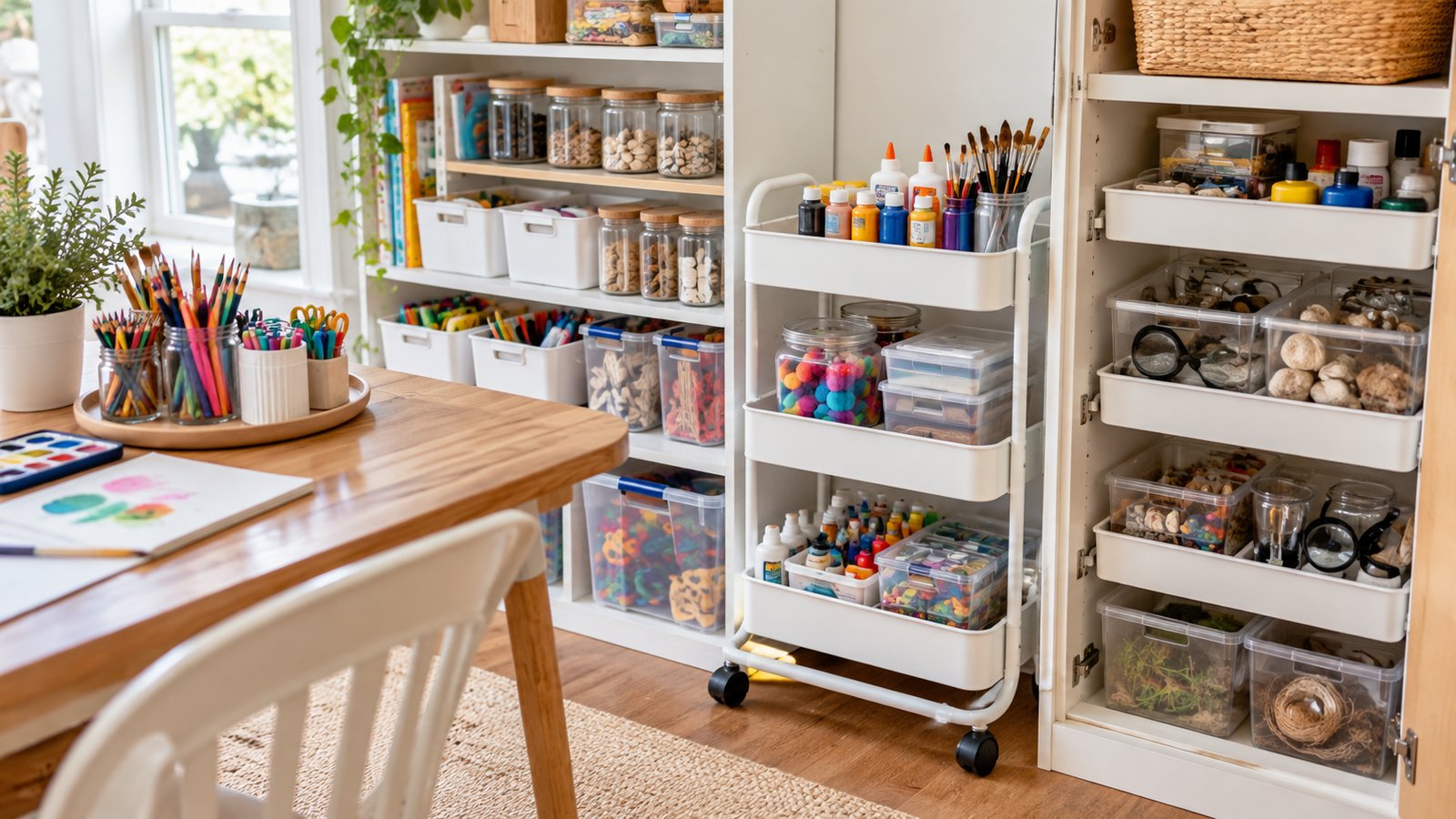
Art supplies spread quickly. A basic kit covers most projects: pencils, crayons, markers, watercolors, glue, scissors, tape, paper and a few brushes. Store it in a single lidded bin. Add specialty items only for specific projects, and put them away afterward.
Science supplies need extra care. Store chemicals, such as vinegar and baking soda, along with any item that could be hazardous, out of reach of young children and away from food. A small bin of reusable tools should hold a magnifying glass, a ruler, measuring cups, droppers, and a notebook. Follow the safety instructions on any kit, and supervise experiments.
Tool and supply labels save time. Use photos or simple words on bins so younger children can help with cleanup. A labeled bin gives each item a home, which makes tidying a routine instead of a battle.
A small basket of fidget items and quiet activities helps children who finish early or need a break, which prevents wandering and reduces interruptions.
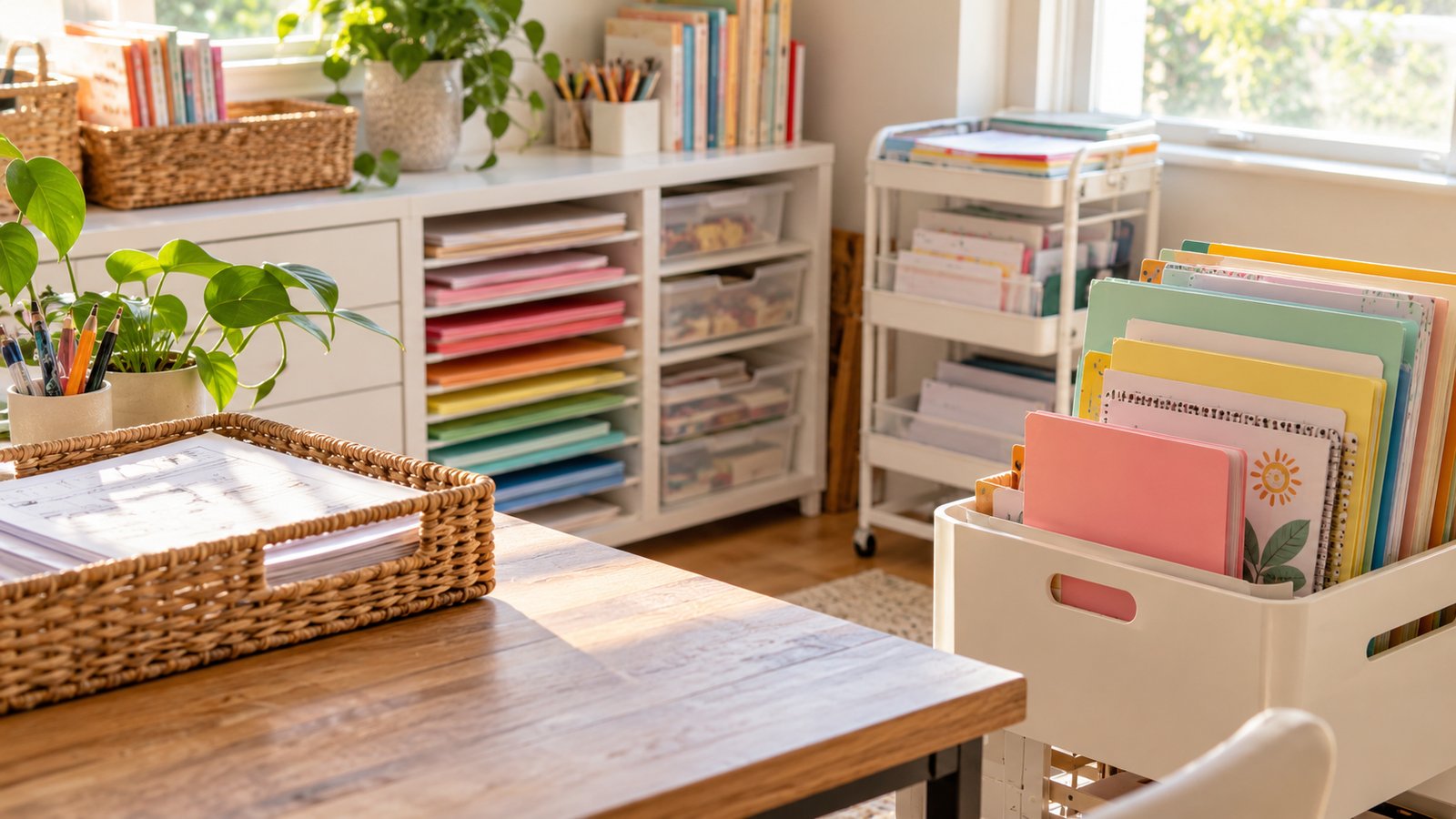
Paper is the quiet clutter. A child can produce several sheets a day, and by spring a stack becomes a wall.
Set a simple system:
Each term, go through the keep box with your child. Choose a few representative pieces per subject, and recycle the rest. Photograph large projects, then let them go. A digital folder organized by year and subject takes no space and works as a record.
Check your state’s rules. Some states require portfolios or records, and you may need to keep certain documents for a set period. Look at your state department of education guidance, and retain what the rules require.
Digitize when you can. Scanning or photographing completed work, and using a cloud folder or hard drive, saves physical space. Back up the files in a second location.
Think about the printer too. Printing worksheets uses paper and ink, and the stack of unused printouts adds clutter. Print only what you need for the week, and consider doing some practice on a whiteboard or in a notebook.
Different rooms offer different opportunities. In a kitchen, the table is the natural classroom, so a cart that tucks into a corner or pantry works well. A drawer or two can hold daily supplies, and the fridge door is handy for a weekly schedule or a list of goals. Remove school supplies at mealtimes so the table stays clean for food.
In a living room, a shelf behind the couch or a console table with baskets stores books and games. A storage ottoman holds blankets and read-aloud books. A small rug marks a reading corner without any furniture at all.
Bedrooms hold more than sleep. Under-bed bins store seasonal materials, and a bookcase can hold a child’s own books and workbooks. A desk may be useful for older students who need quiet, as long as it does not turn into a place for mess.
Hallways and entryways can hold a narrow shelf for library books and backpacks. A hook rail by the door keeps field trip bags ready. Even a bathroom can store extra paper towels, wipes and cleaning supplies for messy projects, so long as they are out of children’s reach.
A first setup can cost very little. Gather what you already own: a laundry basket, shoeboxes, jars for pencils, a bookshelf or a stack of milk crates turned on their sides. Label bins with masking tape and a marker. Add one or two purchases only where the need is clear, such as a rolling cart or a set of stackable bins in one size, so they nest and stack neatly.
Try the system for two weeks before buying more. Watch where things pile up, which items migrate to the table, and what the children use most. Those clues show where storage is missing. Buying after observation prevents the common pattern of buying a lot of containers that do not fit the real problem.
Safety belongs in the plan as well. Store scissors, craft knives and any chemicals where young children cannot reach them, and keep walkways clear so no one trips over a bin. Check that stacked boxes are stable before children climb near them.
Used furniture and secondhand shelves are plentiful at thrift stores, yard sales and community groups. Check that they are sturdy, and anchor tall pieces to the wall.
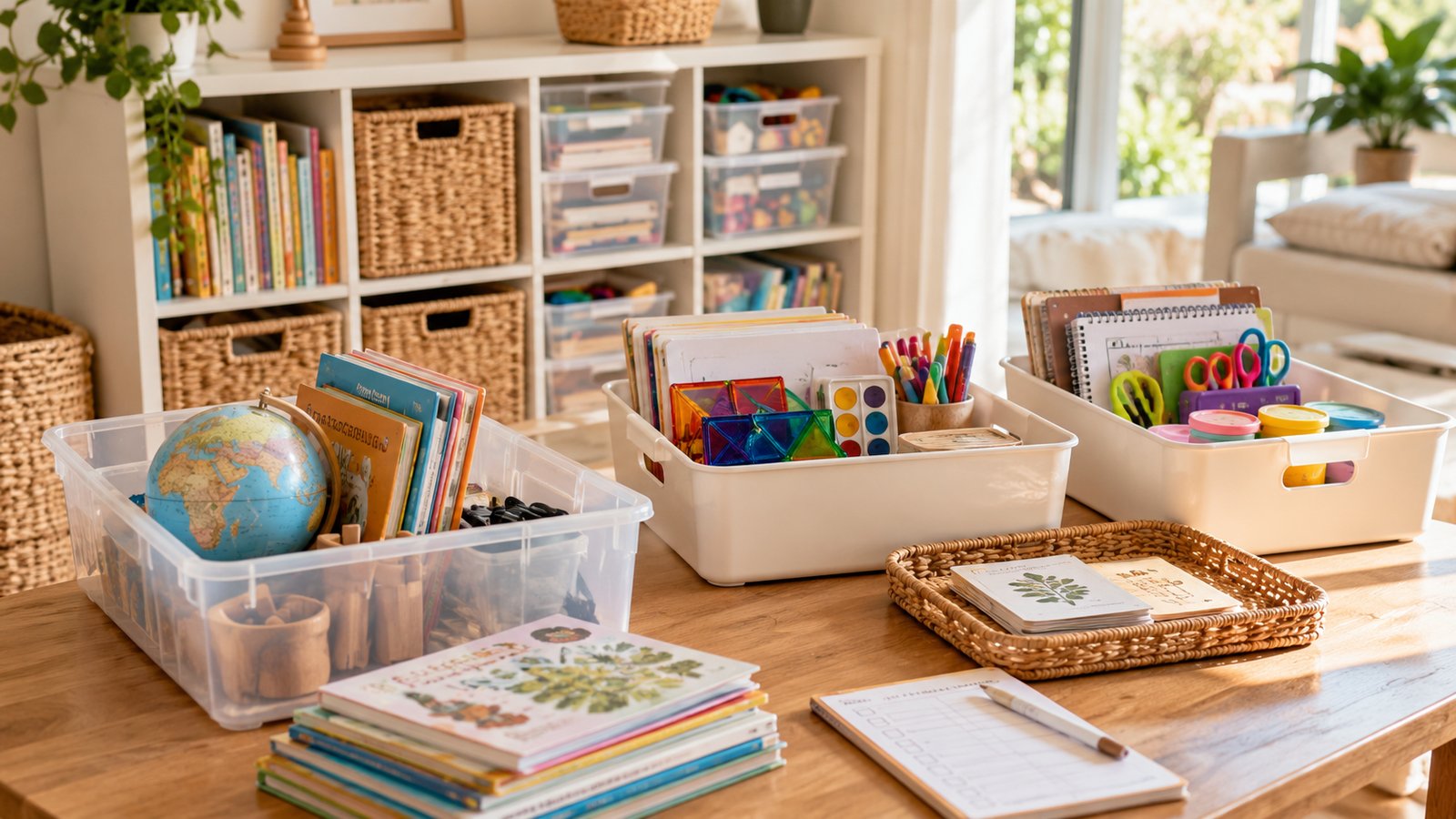
A small-space system succeeds because of maintenance. Build in short resets.
Do a five-minute tidy after lessons each day. Everyone helps, and things go back where they belong. Do a longer reset weekly, putting away the finished bin, restocking pencils and clearing the table.
Every term, review the whole setup. Remove items that no longer fit, add what the next unit needs, and adjust the layout. Children grow and interests change, so the space should change too.
Involve your children. Kids who help pick bins and labels take more responsibility for cleanup. Even young children can sort crayons by color or put books on a low shelf.
Be flexible. Some seasons call for a looser system, such as a new baby or a move. A simple plan you can maintain beats a perfect one you abandon.
Sources worth checking include your state department of education for record-keeping requirements, and your local library for lending and digital resources.
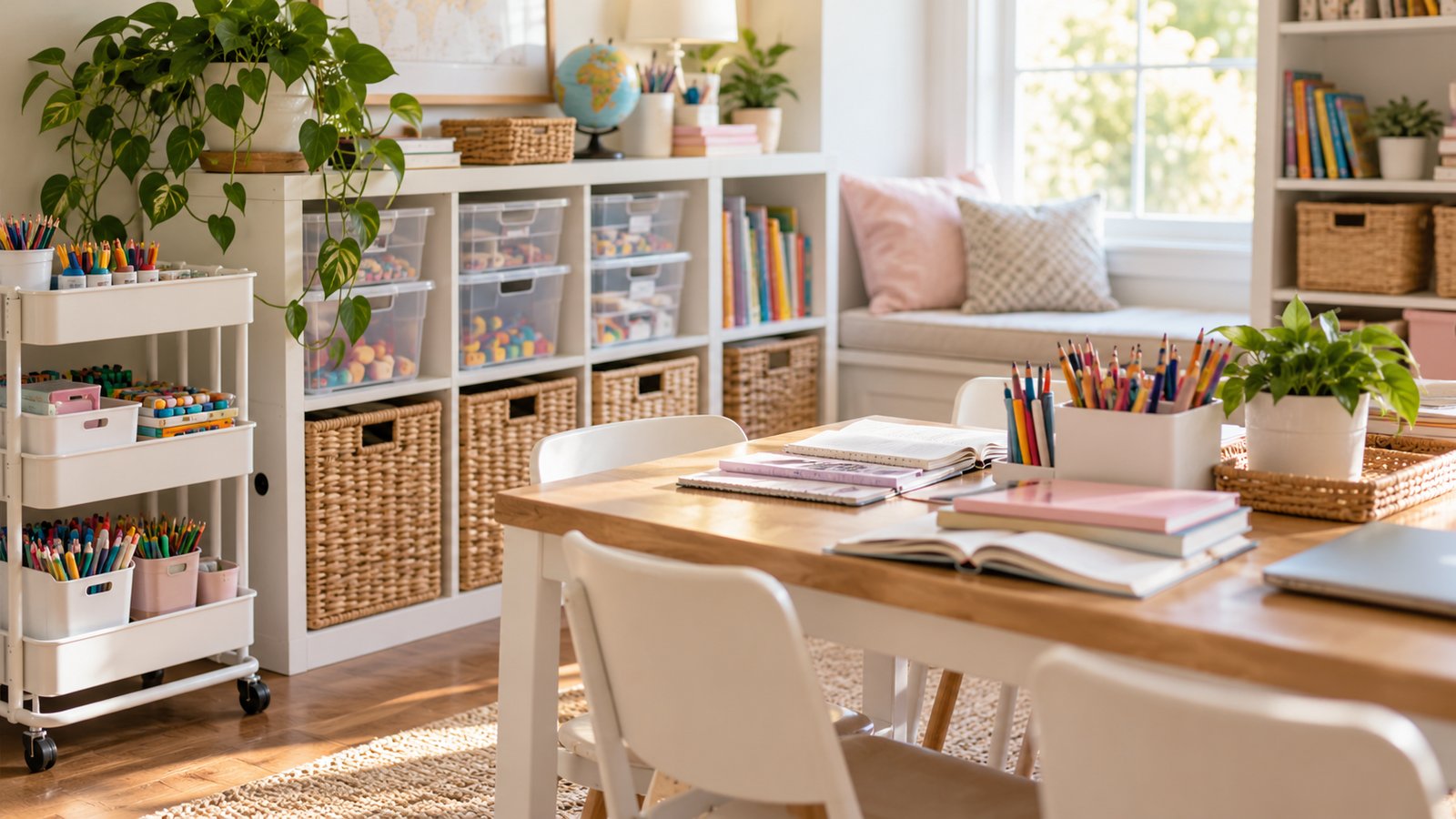
Sort by frequency of use, keep daily items in a portable cart or bin, use vertical and under-bed space for the rest, label everything and rotate materials every few weeks.
Use a to-do tray, a done tray and a keep box, review the keep box each term, photograph large projects and store them digitally, and check your state’s record-keeping rules.
No. Many families use a table, a cart and a few shelves. A portable system lets you clear the space easily after school.
Keep the ones you reread or use as reference, and borrow the rest from the library. Rotate a small selection every few weeks to keep them fresh.
